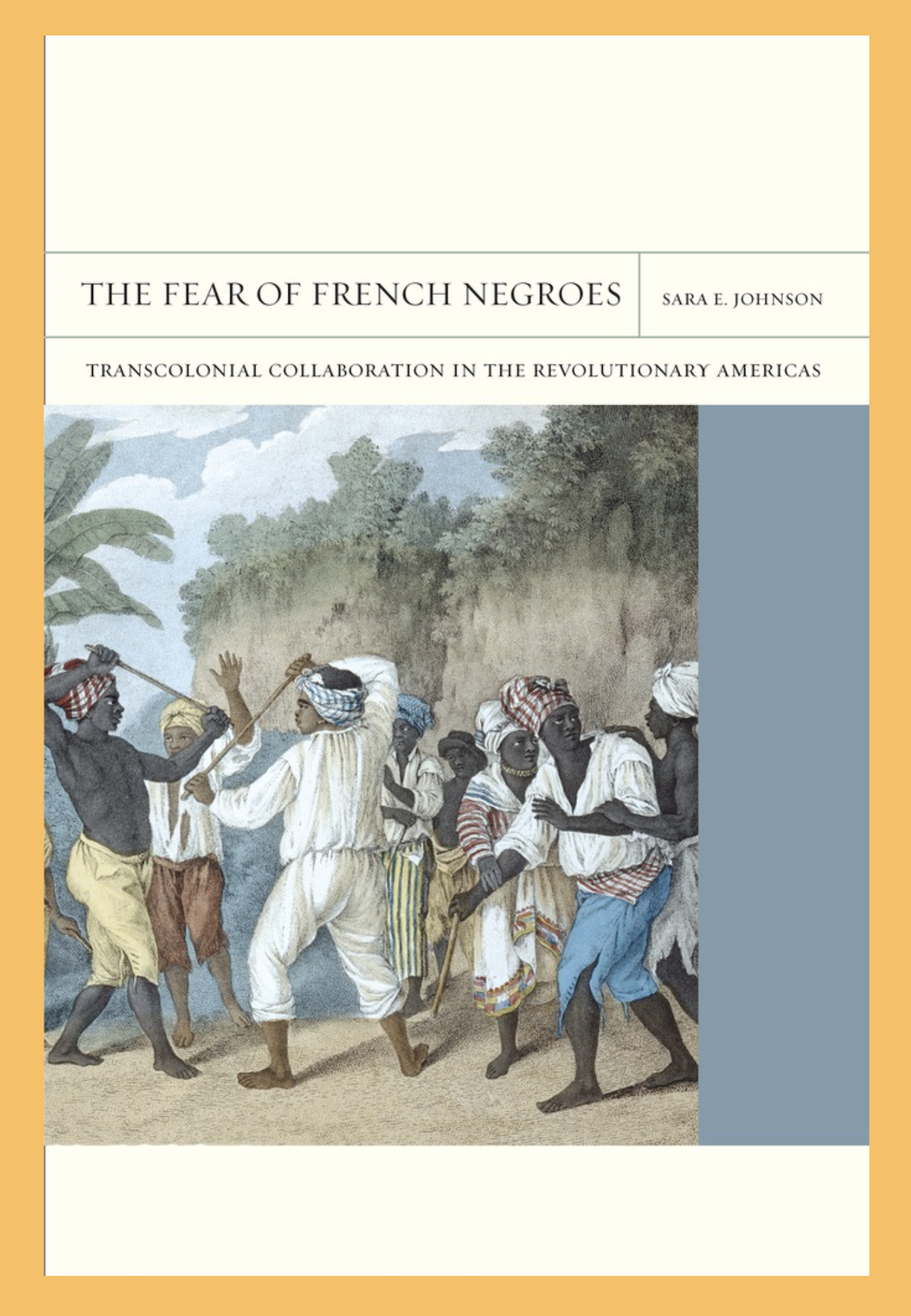
The Fear of French Negroes
Transcolonial Collaboration in the Revolutionary Americas
“The Fear of French Negroes is a well-written, well-researched, and stunning book. Brilliantly, the author has underscored neglected but important geographical origins and dimensions in the formation of what scholars have phrased the Black Atlantic. This literary-cultural-intellectual history persuasively demonstrates the centrality of the Haitian Revolution in the making of Black modernity as well as in the project of transcolonial and transcultural black politics and collaboration.”
—Celucien L. Joseph, Callaloo
═════════════════════════════════════
The Fear of French Negroes is an interdisciplinary study that explores how people of African descent responded to the collapse and reconsolidation of colonial life in the aftermath of the Haitian Revolution (1791-1845). Using visual culture, popular music and dance, periodical literature, historical memoirs, and state papers, Sara E. Johnson examines the migration of people, ideas, and practices across imperial boundaries. Building on previous scholarship on black internationalism, she traces expressions of both aesthetic and experiential transcolonial black politics across the Caribbean world, including Hispaniola, Louisiana and the Gulf South, Jamaica, and Cuba. Johnson examines the lives and work of figures as diverse as armed black soldiers and privateers, female performers, and newspaper editors to argue for the existence of “competing inter-Americanisms” as she uncovers the struggle for unity amidst the realities of class, territorial, and linguistic diversity. These stories move beyond a consideration of the well-documented anxiety insurgent blacks occasioned in slaveholding systems to refocus attention on the wide variety of strategic alliances they generated in their quests for freedom, equality and profit.
Awarded Honorable Mention for the 2013 William Sanders Scarborough Book Prize from the Modern Language Association
Reviews
“By turning the oft-mentioned phrase “fear of French negroes” on its head, she sets out to, among other things, discover African-descended French colonists’ fears—as opposed to European-descended peoples’ fears of black refugees from the French colonies—on their journeys throughout the Americas in the Age of Revolution. […] Rare is the academician who handles print culture, visual culture, and aural culture with such deftness.”
– Matthew J. Clavin, New West Indian Guide/Nieuwe WestIndische Gids
“Johnson finds, analyzes, and draws attention to intellectual thought in sources that have often been neglected by scholars of literature. She defies the disciplinary divisions between art, literature, and history that have sometimes contributed to an ignorance of intellectual life among members of the African Diaspora. In so doing, Johnson has written an impressive analysis of the rippling effects of Haiti's revolution; it goes beyond the oft-written about subject of European fear of "French negroes.””
– Lesley S. Curtis, Louisiana History: The Journal of the Louisiana Historical Association
“With this book, Sara E. Johnson adds to our understanding of the constraints and opportunities available to people of color in the late eighteenth and early nineteenth centuries following the Haitian Revolution […] She provides rich context for these lives, examining layers of local and international influences. Her analysis reveals complex communities that were not homogenous—as they appear in the telling of many American observers of the Caribbean—but pierced by class, color, and slave/free divisions. Placing her work in the field of interdisciplinary studies—the creole states of academia—she draws on an impressively multimedia trove of stories, images, music, and dance, to argue for the “transcolonial collaboration” among those of African descent in the world of the Afro-Caribbean.”
– Sara Fanning, Journal of World History