
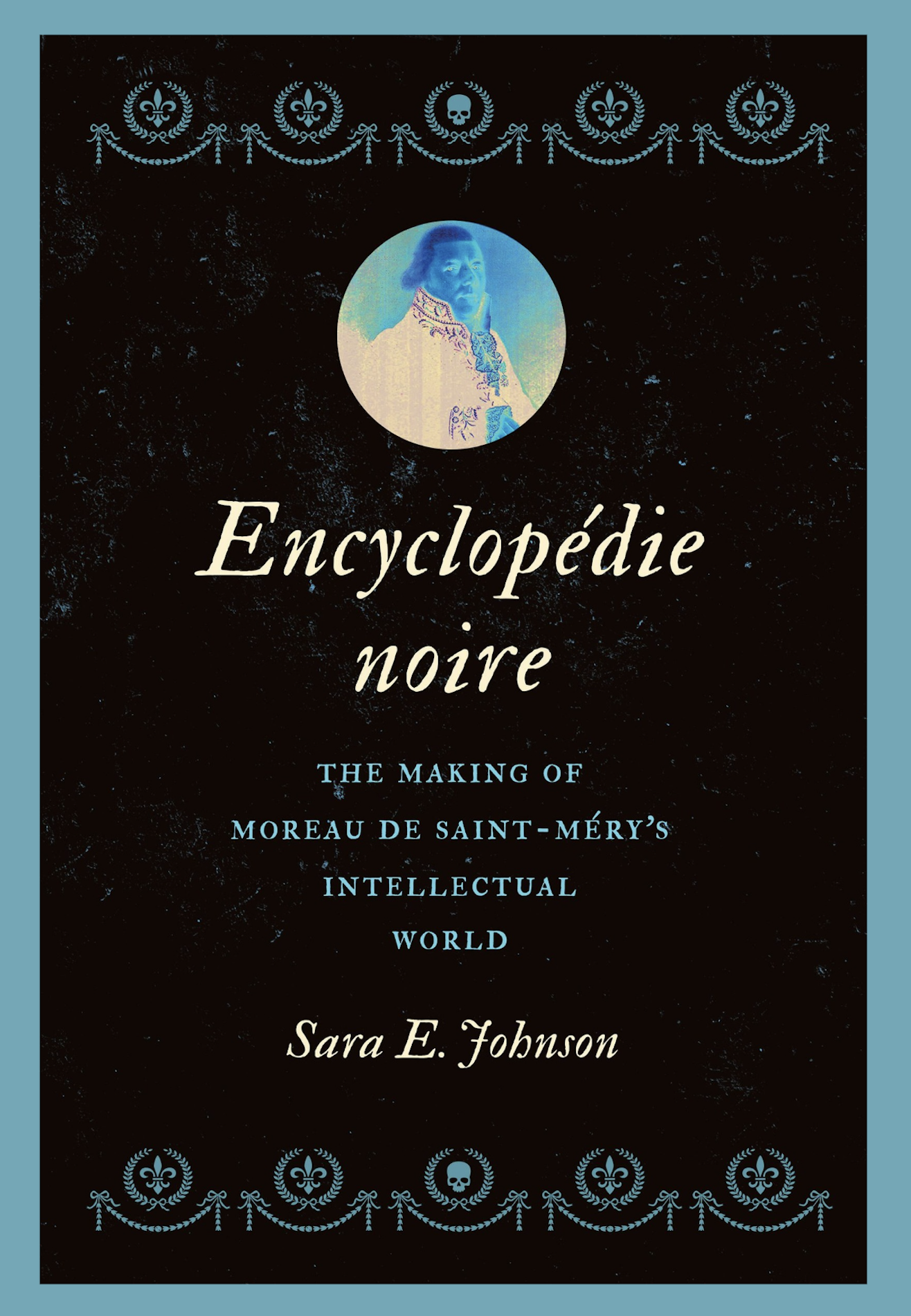
Encyclopédie noire
The Making of Moreau de Saint-Méry's Intellectual World
“Encyclopédie noire is an utterly original examination of the work and impact of Moreau—and so much more. Through gorgeous prose and meticulous close readings across a vast array of sources and languages, Johnson marginalizes Moreau to create a ‘communal biography’ that centers the lived experiences of the women and men he enslaved. Moving across disciplines and methodological boundaries to breathtaking effect, Johnson illuminates how the European Enlightenment and Black Atlantic were inextricable from each other. This book will forever change the way we think about the fields of both literary studies and history. This is the book we have been waiting for.”
— Jennifer L. Morgan, New York University
═══════════════════════════════════════════════
If you peer closely into the bookstores, salons, and diplomatic circles of the eighteenth-century Atlantic world, Médéric Louis Élie Moreau de Saint-Méry is bound to appear. As a lawyer, philosophe, and Enlightenment polymath, Moreau created and compiled an immense archive that remains a vital window into the social, political, and intellectual fault lines of the Age of Revolutions. But the gilded spines and elegant designs that decorate his archive obscure the truth: Moreau’s achievements were predicated upon the work of enslaved people and free people of color. Their labor afforded him the leisure to research, think, and write. Their rich intellectual and linguistic cultures filled the pages of his most applauded works. Every beautiful book Moreau produced contains an embedded story of hidden violence.
Sara Johnson’s arresting investigation of race and knowledge in the revolutionary Atlantic surrounds Moreau with the African-descended people he worked so hard to erase, immersing him in a vibrant community of language innovators, forgers of kinship networks, and world travelers who strove to create their own social and political lives. Built from archival fragments, creative speculation, and audacious intellectual courage, Encyclopédie noire is a communal biography of the women and men who made Moreau’s world.
Awards
Co-Winner, Frederick Douglass Book Prize, Gilder Lehrman Institute of American History and Center for the Study of Slavery, Resistance, and Abolition (2024)
Aldo and Jeanne Scaglione Prize for African Studies, Modern Language Association (2024)
J. Russell Major Prize in French History, American Historical Association (2024)
Mary Alice and Philip Boucher Book Prize, French Colonial Historical Society (2024)
P. Sterling Stuckey Book Prize, Association for the Study of the Worldwide African Diaspora (2024)
Honorable Mention, Gilbert Chinard Book Prize, The Society for French Historical Studies (2024)
Shortlist, Kenshur Prize, Center for Eighteenth-Century Studies (2024)
Finalist, Susanne M. Glasscock Book Prize, Melbern G. Glasscock Center for Humanities Research (2024)
Reviews
“With her spectacular new book Encyclopédie noire: The Making of Moreau de Saint-Méry’s Intellectual World, Sara E. Johnson steps out as one of the most important voices in this field. Her book is groundbreaking in many regards … a remarkable book, a must-read for anyone interested in the eighteenth century, in slavery, in biography, in intellectual history, in archives – or in history-writing in general. For a book that is so profoundly researched and theorized, it is also an outstanding read.”
— Alyssa Goldstein Sepinwall, Age of Revolutions
“The skeleton of Johnson’s work is an encyclopedia, an Enlightenment-era pretention to universal knowledge that was also an instrument in the colonial search for knowledge and mastery over things and people. But Johnson’s penultimate chapter upends this pretention with an enormously creative meditation of enslaved literacy, of what Africans would have made of the upside-down brands on their own flesh, of printed runaway advertisements, or of the words spoken by slave owners. On Johnson’s pages, European knowledge and language literally break down (“essssssssskkkkkkkkkkllllllllllavvvvvv [short e in an English context]; esklave = vika? Esklav ¹ vika? Esklav = mvika?,” Johnson writes, to explore how a Kikongo speaker might have heard and understood a slave owner’s words). The form of the chapter suggests that historians of enslaved people can only write by fiction or cacophony; nothing else is salvageable from the archives of slavery. Johnson’s African subjects are, in the end, knowable only through radically novel historical method.”
– Maria Cecilia Ulrikson, Public Books
“[A]s Sara E. Johnson points out in her book… Médéric Louis Élie Moreau de Saint-Méry was only able to be Moreau because of the Black bodies that were compelled to impart their knowledge, feed his children, contribute their labor, and satisfy his lust. But what happens if he himself becomes the scrutinized? Johnson uses Moreau’s works to unpack the myth that he created about himself, and thus requires us to reexamine his life as an enslaver: of people, of writings, and of ideologies. Many historians since my graduate years have questioned Moreau’s interpretations; none have done so more forcefully, brutally, and elegantly than Johnson…Her efforts recover (if only in glimpses) the people who worked in his home or workshop, who shared his bed, and who withstood his scrutiny and surveillance; they now appear in all their complexity. I can think of nothing more meaningful to say other than when graduate students approach me to understand a place like Saint Domingue, I am able to tell them that they should start with Sara E. Johnson.”
- Robin Mitchell, American Historical Review
“In bringing Moreau’s enslaved informants to the fore and regarding them as producers of ideas in their own right, Encyclopédie noire joins a growing body of scholarship that has broadened the scope of intellectual history by reconsidering who counts as an intellectual, where ideas are produced, and what forms they take. As scholars of African American intellectual history have insisted, enslaved people were “organic” intellectuals whose thoughts need to be unearthed, including in such unexpected places as Moreau’s published writings and personal papers. Of course, there is nothing straightforward about the process of recovering them. Moreau’s archive needs to be read against the grain—that is, not as Moreau intended—which Johnson convincingly does. Encyclopédie noire is as much about the intellectual world of the enslaved women, men, and children Moreau wrote about than it is about Moreau’s.”
– Michaël Roy, American Literary History
“Johnson's stunning encyclopedia, grounded in Black thought and community, is designed as an “antidote” to the “poison” that Moreau, men like him, and the scholars who follow them have long put into Caribbean art, language, literature, and history… At the heart of this act of scholarly rigor and artistic creation there are pain and generosity, trauma and pleasure, disgust and love, all at once. It is the greatest book that I have read in a long time.”
– Allison Margaret Bigelow, Hispanic American Historical Review
“[Johnson’s] methodologically original and exciting work challenges historians of science, law, and language, as well as those who study the literary and visual culture of the eighteenth century, to not only recognize that creole intellectuals like Moreau accomplished ‘these things because of, not despite, [their] investment in slavery’, but further to envision and present the interior lives and lived experience of those they enslaved. Through her masterful use of varied archival sources and creative deployment of contemporary reimaginings of historical materials, Johnson brings forward a cast of people—hairdressers, wet nurses, translators, bookbinders, laundresses, cooks—whose invisible labor and knowledge we encounter when we study the eighteenth century.”
– Anna K Sagal, Leah Benedict, & William J Ryan, The Year's Work in Critical and Cultural Theory
“Johnson’s Encyclopédie noire is timely in two ways. It is the first monograph published about Moreau in ninety years, which makes it a valuable resource for the historians of slavery, dance, language, religion, and other fields who rely on his writings. More importantly, Johnson considers Moreau and his world using recent critical approaches in Black studies scholarship in addition to archival research. The result is a book that is sometimes a standard cultural history and sometimes quite unconventional, an important and ardently argued contribution to the ethics of the colonial archive.”
— John Garrigus, H-Early-America
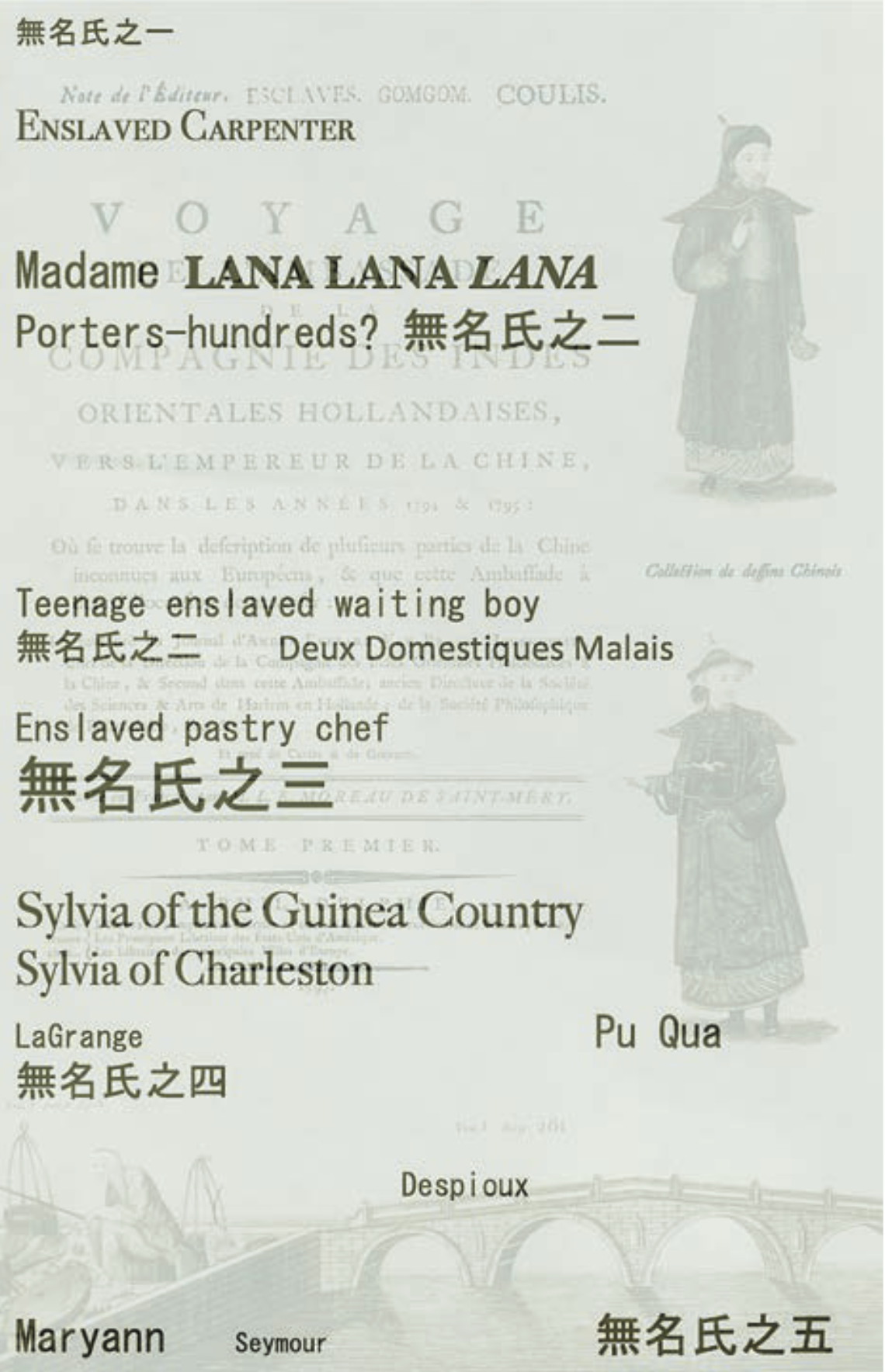
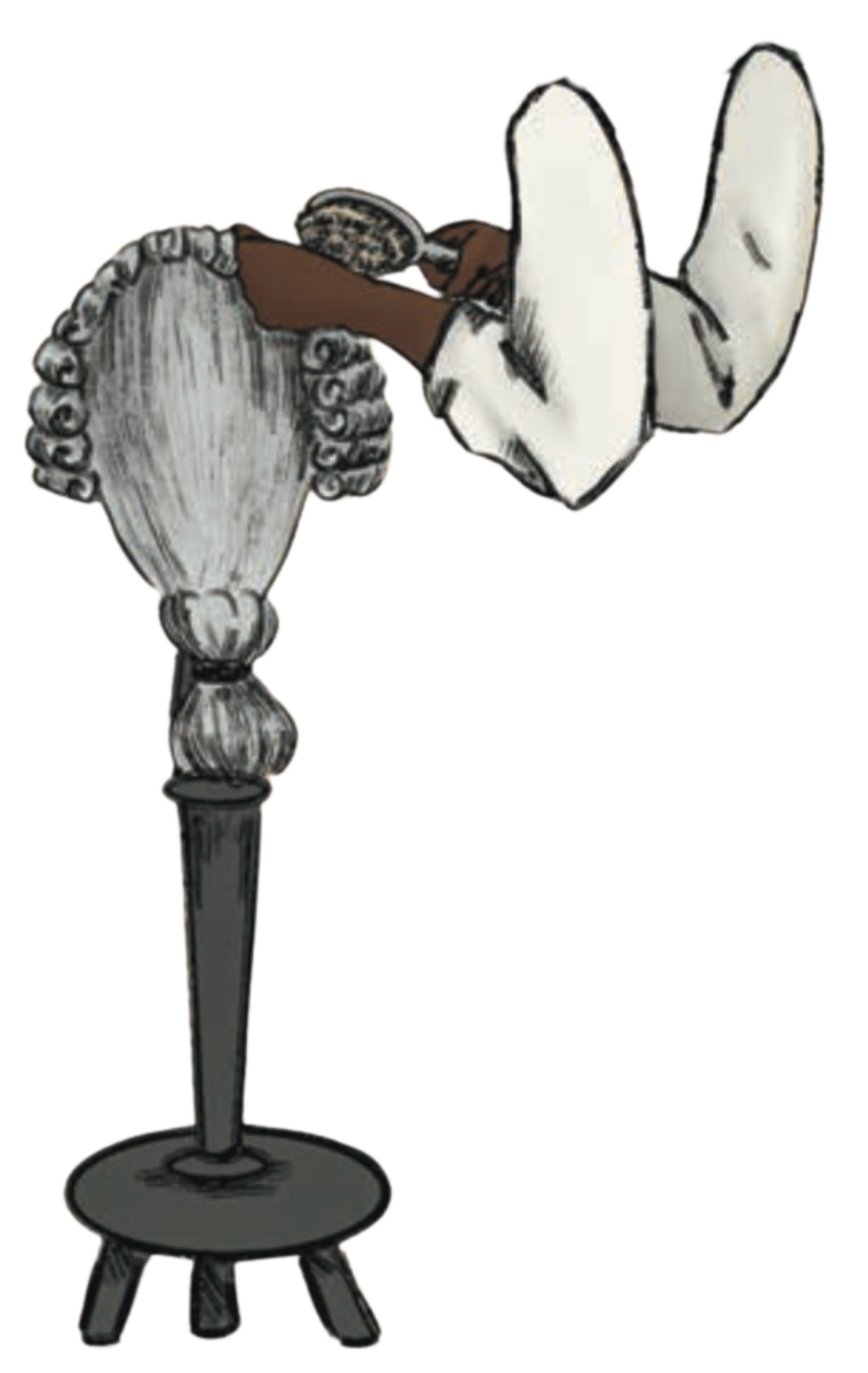
From left to right: 1. Composite title page 2 adapted from M. L. E. Moreau de Saint-Méry, ed. and trans., Voyage de l’ambassade de la Compagnie des Indes orientaleshollandaises, vers l’empereur de la Chine, dans les années 1794 et 1795 . . . Le touttiré du journal d’André Everard van Braam Houckgeest. . . , I (Philadelphia, 1797). By Luz Sandoval and Sara E. Johnson. 2. Original ensemble view of engravings, Blanchisseuses, Affranchis des colonies, Danse de nègres, and Nègres jouant au bâton. Engraved by Nicolas Ponce, after Agostino Brunias. Nicolas Ponce, Recueil de vues des lieux principaux de la colonie française de Saint-Domingue (Paris, 1791), no. 26. 3. Portrait Collage of Moreau de Saint-Méry, Part I, from Encyclopédie noire 4. Moreau dévoilé: A Portrait Collage, Part II, from Encyclopédie noire. 5. Marielle Plaisir, Variation on Lámina 23, from The Book of Life. For more of Marielle Plaisir’s work, visit her website.